Alan Thicke Net Worth: The $40 Million Myth vs. The Real Story His Family Fought Over
When Alan Thicke died in December 2016, the world knew him as America’s favorite TV dad from Growing Pains. In the wake of his passing, headlines suggested a fortune of around $40 million. But that number was both a fact… and a complete fiction. Because when it came time to settle his estate, his family entered a legal battle that revealed a far more complicated — and considerably smaller — figure. So where did the money really go? And why can no one agree on alan thicke net worth to this day?
More Than Just a TV Dad
For an entire generation, Alan Thicke was Dr. Jason Seaver — the warm, funny patriarch from the hit sitcom Growing Pains. That role made him a household name across the United States. But defining his career by that one part would be like judging an iceberg by its tip.
Before he became America’s dad, Thicke was a prolific force behind the scenes. He was an accomplished songwriter, a charming talk show host, and a go-to producer. This was not a career built on a single stroke of luck. It was built systematically, over decades.
In the 1970s and 80s, if you were watching TV, you were likely hearing Alan Thicke’s work without even knowing it. He composed some of the most iconic theme songs in television history. The catchy tunes for shows like Diff’rent Strokes and The Facts of Life came from his pen. He even wrote the original theme for Wheel of Fortune, which aired from 1975 to 1983. These were not just one-off jobs. They were sources of royalties that provided steady income for decades.
Then, he stepped in front of the camera. In Canada, he hosted The Alan Thicke Show, a popular daytime talk show that made him a star in his home country. His role as Dr. Jason Seaver from 1985 to 1992 then launched him into full superstardom in the United States. Even after Growing Pains ended, he kept working — acting, making guest appearances, hosting specials. This was a man who was always in motion.
That hustle, over a lifetime, is the entire foundation of that $40 million net worth estimate. The number made sense because it reflected a genuinely enormous body of work.
The $40 Million Number — and Why It Began to Crumble
On December 13, 2016, the story took a sharp and tragic turn. Alan Thicke was playing hockey with his youngest son, Carter, when he collapsed. He died later that day from a ruptured aorta. He was 69 years old.
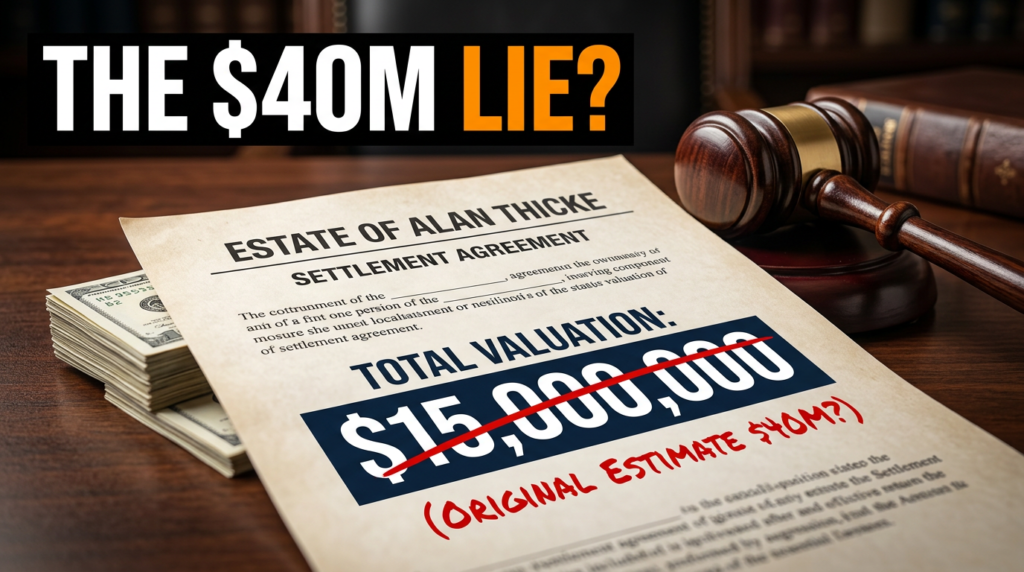
Almost immediately, the narrative of a tidy $40 million fortune started to fall apart. As the estate settlement process began, a very different number started appearing in legal filings — an estate valued at approximately $15 million. According to documents from the time, Thicke himself had listed his net worth as $14 million in the 2005 prenuptial agreement.
So what happened to the other $25 million?
This is where we hit the central secret of almost all celebrity fortunes. A “net worth” is an estimate — a snapshot calculated by journalists and financial websites. It is speculative, and often inflated. An “estate value,” on the other hand, is the figure that actually matters in a courtroom. It is the valuation of assets that are legally transferable after death. It accounts for taxes, outstanding debts, legal fees, and the obligations buried in trusts and prenups. The distributable assets are almost always a smaller, more sobering number.
Alan thicke net worth and the Family Feud That Followed
Thicke had been married three times. He had three sons: Brennan and Robin from his first marriage, and Carter from his second. His third wife, Tanya Callau, had been married to him since 2005. To protect his assets for his children, Thicke had Callau sign a prenuptial agreement before the wedding. It was a clear, deliberate move designed to prevent exactly the kind of conflict that was about to unfold.
It did not work — at least, not cleanly.
The battle lines were drawn between Thicke’s two eldest sons, Brennan and Robin, who were co-trustees of his estate, and his widow, Tanya Callau. The conflict centred on a fundamental disagreement over what Callau was entitled to inherit. At the heart of it were two key documents: the prenuptial agreement from 2005 and an updated living trust from 2016.
According to the prenup, Callau was to receive a $500,000 life insurance policy, 25% of Thicke’s personal effects, and the right to continue living at their sprawling 11-acre ranch in Carpinteria, California — as long as she maintained the property. However, Thicke’s sons filed a petition in May 2017, claiming that Callau was contesting the prenup and demanding a larger share of the estate. Their filing alleged she was threatening to go to the tabloids if her demands were not met. Callau’s lawyer, Adam Streisand, fired back sharply — calling the lawsuit a “distasteful smear tactic” designed to bully her, and stating that Callau had never sought anything beyond what her husband intended. According to legal experts who reviewed the case, estate disputes like this one are often triggered precisely by the gap between what a prenup says and what a later trust document reflects.
A judge eventually dismissed the sons’ petition, noting that there was no actual evidence Callau was planning to sue.
But the conflict had already revealed some crucial gray areas. The prenup, for instance, appeared to entitle Callau to partial ownership of the ranch. The updated trust, on the other hand, only gave her the right to live there — not to own any part of it. These kinds of ambiguities are exactly what fuel expensive, emotionally exhausting legal fights.
The fight also got personal. Callau claimed that Thicke’s sons refused to reimburse her for his gravestone, while her team noted that Robin received more than $105,000 in reimbursement for a lavish memorial party held the night before the burial—an event she never approved.
According to Variety, the ranch at the centre of the dispute was valued at approximately $3.5 million.
Ultimately, a settlement was reached. Callau received 40% of the estate — a larger share than the original 25% stipulated in the prenup — while each of Thicke’s three sons received 20%. She also retained the right to live at the ranch. The fight was over. But it had laid bare the complicated reality behind the number everyone thought they knew.
What Alan Thicke’s Fortune Really Tells Us
So what does this saga actually prove?
It proves that a celebrity’s wealth is often a far more complex picture than a single number can represent. The $40 million figure was not a lie — it was a broad estimation of a lifetime’s worth of assets. But that number never accounted for taxes, legal fees, debts, and the intricate obligations woven into trusts and prenuptial agreements.
Thicke’s story is also, in many ways, a masterclass in building a durable entertainment career. His wealth did not come from one lottery-ticket movie role. He grew it slowly and methodically through decades of steady work in different parts of the industry. His royalties from composing television theme songs, in particular, created a financial bedrock that insulated him from the natural ups and downs of an acting career. As Forbes has noted about entertainers who build lasting financial stability, diversified income streams — rather than single blockbuster paydays — tend to create far more durable wealth over time.
That model feels almost old-school today. Thicke built his fortune the hard way: by being a multi-talented professional who was always working.
At the same time, his estate story serves as a genuine cautionary tale about planning for blended families. Thicke did a lot of things right. He had a trust, a will, and a prenup. He clearly intended to provide for both his wife and his children. But the potential conflicts between those documents — combined with the raw emotion that always follows a sudden death — created a perfect storm. Once someone dies, money becomes more than just money. It becomes a symbol of love, legacy, and respect.
For anyone navigating a similar family situation, legal experts at the American Bar Association recommend regular reviews of estate documents to ensure that trusts and prenuptial agreements remain aligned, especially after major life events.
The Headline vs. The Reality
In the end, Alan Thicke was more than a TV dad, and his financial story is more than just a headline number.
The discrepancy between the estimated net worth and the smaller estate value was not about hidden losses or scandal. It was simply the messy, human process of untangling a life’s worth of assets, obligations, emotions, and legal documents. It is a reminder that a person’s public net worth is a headline — but their estate is the final chapter.
And those two things are almost never the same.
FAQ Section
Q1: What was Alan Thicke’s net worth at the time of his death?
A: Public estimates placed alan thicke net worth at around $40 million. However, court and estate documents at the time of his death pointed to a figure closer to $14–16 million.
Q2: How much was Alan Thicke’s estate worth?
A: Legal filings placed the value of his estate at approximately $14–16 million, significantly lower than the widely reported $40 million figure.
Q3: Who inherited Alan Thicke’s estate?
A: Following a legal settlement, his widow Tanya Callau received 40% of the estate and the right to live at the Carpinteria ranch. Each of his three sons — Robin, Brennan, and Carter — received 20%.
Q4: Why did Alan Thicke’s family fight over his estate?
A: The dispute stemmed from apparent conflicts between the 2005 prenuptial agreement and the 2016 updated living trust, particularly regarding ownership and inheritance rights tied to Thicke’s Carpinteria ranch.
Q5: How did Alan Thicke make his money?
A: Thicke earned his fortune through a combination of acting (most notably Growing Pains), composing TV theme songs for shows like Diff’rent Strokes and The Facts of Life, hosting talk shows, and producing — building royalty income across multiple decades.