
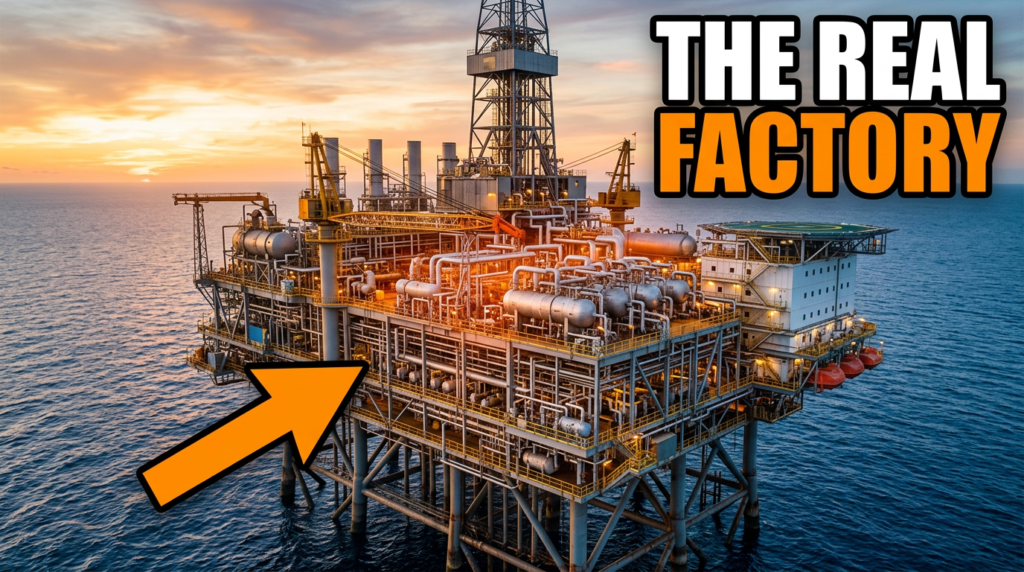
Topside Facilities: The Hidden Heart of Every Offshore Oil Rig
When you picture an offshore oil rig, you probably focus on the towering steel legs, the iconic derrick reaching skyward, or the flare stack burning against an open sea. These are the dramatic visuals — and they are genuinely staggering in scale and cost. But none of them are the most expensive part of the structure. That title belongs to the topside facilities — the dense, sprawling deck of machinery sitting above the waterline. Most people overlook it entirely. Engineers know it as the operational heart, the economic engine, and the reason the entire platform exists in the first place.
The Usual Suspects: What Makes a Rig Look Expensive
To understand why topside facilities carry such enormous price tags, you first need to appreciate what lies beneath them. The foundation of a fixed offshore platform is the jacket — a massive steel lattice structure pinned to the seafloor with piles driven hundreds of feet into the seabed.
For floating platforms like spars or tension-leg platforms, intricate mooring systems hold the structure in place against storms and deep-ocean currents. The Perdido platform in the Gulf of Mexico, the world’s deepest spar-type platform, floats in approximately 2,450 meters — nearly 8,000 feet — of water. Designing, fabricating, and installing that kind of foundation costs hundreds of millions, often more.
The Drilling Package and Risers
Then there is the drilling package. This is not a simple drill. It is a highly automated system capable of boring through miles of rock with surgical precision. It includes the derrick, draw-works for hoisting enormous loads, a top drive for rotating the drill string, and blowout preventers engineered to contain immense reservoir pressures. A modern drilling rig, even without the platform, represents a monument to mechanical engineering.
Finally, risers connect the seafloor to the surface. These are not simple pipes — they are complex conduits that flex and move with the platform while safely transporting high-pressure mixtures of oil, gas, and water from the seabed. In deep water, riser systems alone represent a significant engineering challenge and a major budget line.
All of these components are essential. But they all serve one purpose: getting raw, unprocessed fluid from the reservoir to the surface. And almost none of that raw fluid is useful until someone processes it. That is where topside facilities take over.
What Topside Facilities Actually Are
The topside is the part of the platform that sits above the water. It is the crowded, pipe-covered deck that looks like a tangled industrial mess from a distance. Most people assume it is simply the top of the rig — a platform for equipment and crew. That assumption undersells it by an enormous margin.
Topside facilities form a fully integrated, multi-billion-dollar floating factory. Installed costs for complex topsides typically run in the range of $35,000 to $50,000 per ton, though that figure varies considerably by project complexity. On a large platform where the topsides weigh 20,000 to 40,000 tonnes or more, the numbers become staggering. The topsides for the Gullfaks C platform in the North Sea weigh approximately 49,000 tonnes. The Berkut platform’s topsides — part of the Arkutun-Dagi development in Russia, which cost around $12 billion in total — tip the scales at roughly 42,000 tonnes.
The Processing Chain: From Raw Fluid to Sellable Product
The primary job of topside facilities is to take the chaotic, high-pressure mixture arriving from the wells — crude oil, natural gas, water, sand, and other solids — and separate it into clean, stable, transportable products.
That process happens in stages. First, the fluid enters primary separators — large pressure vessels that use gravity and pressure control to let gas rise, oil form a middle layer, and water and solids settle at the bottom. The oil then moves through further treatment to remove dissolved gases and reach a stable condition suitable for storage and export. The natural gas gets treated and compressed, either for pipeline export, reinjection into the reservoir to maintain pressure, or use as fuel for the platform itself. Produced water — which can make up a very high proportion of total fluid volume — goes through hydrocarbon removal to meet strict environmental discharge limits before returning to the ocean.
Each of these steps demands its own specialized, heavy-duty equipment: separators, scrubbers, heaters, coolers, pumps, and large compressors. All of this machinery, which would occupy a sprawling onshore refinery complex, must fit into a compact footprint on the platform deck.
The Self-Contained City Above the Water
But processing hydrocarbons is only half the job. Topside facilities also function as a self-contained city. Large gas turbines — units capable of powering a small town — generate the platform’s electricity. Separate utility systems handle water treatment, waste management, and compressed air supply. The central control room acts as the brain of the entire operation, monitoring every sensor and every automated system on the platform.
Extensive fire and gas detection systems, alongside emergency shutdown logic, provide the safety layer that makes working in this environment survivable. On many platforms, the topsides also include full accommodation blocks: cabins, kitchens, medical facilities, and recreation areas for crews ranging from a few dozen to over two hundred people. According to Wired’s feature on the engineering extremes of offshore oil infrastructure, the challenge of integrating all these systems into a single coherent unit — while managing weight, access, and safety simultaneously — is what makes offshore topside engineering one of the most demanding disciplines in the industry.
Every module adds weight that the hull or jacket must support. Every pipe and cable between modules requires careful routing, because there is no room for rework once the platform is installed hundreds of miles offshore. Engineers must orient rotating equipment to counteract the roll of the vessel and design maintenance pathways that crews can safely navigate in all weather conditions.
Why Topside Facilities Matter Beyond the Platform
Understanding topside complexity changes how you see the entire offshore energy industry. Without the processing capability sitting on top, the jacket, drilling rig, and risers are simply an extremely expensive delivery system. Topside facilities are where value actually gets created. They transform a raw, unusable resource into the stable crude oil and pipeline-ready natural gas that global markets can trade.
This processing capability is also what makes remote deepwater fields commercially viable. A vessel type called an FPSO — Floating Production, Storage, and Offloading unit — demonstrates this perfectly. An FPSO carries a full topside processing facility on its deck, allowing it to produce, process, and store oil in a single mobile unit, then offload directly to tankers. This technology unlocks reserves in locations where no pipeline infrastructure exists and no fixed platform is economically justifiable.
The Human Cost of Design Decisions
Topside design also carries direct consequences for the people living inside it. A well-designed topside — with logical equipment layouts, clear access routes, and effective safety barriers — makes the job of offshore workers safer and less physically demanding. A poorly designed one, where maintenance access is awkward or escape routes are indirect, adds real risk to an already hazardous working environment.
The decisions engineers make years before a platform is ever installed shape daily life for crews working hundreds of miles from shore. As MIT Technology Review has noted in its analysis of safety engineering in extreme industrial environments, the integration of digital monitoring systems into offshore facilities is one of the most promising paths toward reducing both human error and structural risk in these settings.
Every design decision on a topside involves trade-offs. Adding more processing equipment offshore reduces the burden on onshore terminals but increases platform weight and cost. More weight demands a larger, stronger — and more expensive — substructure below. Every project requires a unique balance between performance, safety, weight, and budget, tailored specifically to the conditions of that field.
How Topside Facilities Are Evolving
The world of topside engineering is not standing still. As pressure grows to reduce emissions, cut costs, and operate in harsher environments, floating factories are evolving in new directions.
One of the biggest shifts is toward digitalization. The next generation of platforms uses digital twins — detailed virtual models of the entire facility. Before any steel is cut, engineers simulate fluid flow, structural stress, and equipment performance. This process helps uncover design issues early and reduces rework. In addition, operators can train on a digital replica before working on the actual platform.
Electrification is another major trend, especially in the North Sea. Traditionally, platforms burned their own produced gas to generate power — a significant source of emissions. An emerging alternative connects platforms to onshore power grids via high-voltage subsea cables. Others integrate with nearby offshore wind farms, using renewable electricity to run the topsides entirely. This shift cuts the carbon footprint of offshore operations substantially.
The engineering principles behind topside facilities are also finding new applications entirely. The next generation of offshore structures may move beyond oil. They could support renewable energy projects, carbon storage operations, and green hydrogen production. The floating factory is learning to produce more than just hydrocarbons.
FAQ — Topside Facilities
Q1: What are topside facilities on an offshore platform?
A: Topside facilities refer to all the processing equipment, utility systems, safety infrastructure, and accommodation that sits above the waterline on an offshore oil or gas platform. Acting as an integrated floating factory, these vessels process raw well fluid into stable, exportable crude oil and natural gas. Beyond production, they provide living quarters for the crew while also generating the power needed to keep the platform running.
Q2: Why are topside facilities often the most expensive part of an offshore rig?
A: The installed cost of complex topsides typically runs between $35,000 and $50,000 per ton. On large platforms where the topsides weigh 20,000 to 40,000 tonnes or more, total costs can exceed the substructure below. Every system must work together in a compact, weight-optimized package. This includes processing, power generation, safety, and accommodation facilities. The entire setup must operate reliably in one of the world’s harshest environments.
Q3: What does a topside processing facility actually process?
A: The raw fluid arriving from offshore wells is a high-pressure mixture of crude oil, natural gas, water, sand, and other contaminants. Topsides separate this mixture into its components: stabilized crude oil, treated gas, and cleaned produced water. They use separators, scrubbers, heaters, compressors, and other specialized vessels.
Q4: What is an FPSO and how does it relate to topside facilities?
A: An FPSO, or Floating Production, Storage, and Offloading vessel, is a ship-shaped unit with a full topside processing facility on its deck. It can produce, process, and store oil in a single mobile unit before offloading to shuttle tankers. FPSOs make it economically viable to develop deepwater and remote fields where fixed platforms or pipelines would be impractical.
Q5: How much do offshore platform topsides weigh?
A: Topside weight varies enormously by platform type and processing requirements. The Gullfaks C topsides in the North Sea weigh about 49,000 tonnes. Meanwhile, the Berkut platform’s topsides in Russia weigh roughly 42,000 tonnes. Smaller platforms can have topsides weighing a few thousand tonnes, while the largest FPSOs carry topsides far exceeding those figures.
Q6: What safety systems are included in topside facilities?
A: Topsides integrate multiple safety layers: fire and gas detection sensors, automated emergency shutdown systems, deluge and suppression systems, and blast-rated walls between high-risk areas. The central control room monitors all systems continuously. Muster stations, lifeboat launching systems, and clear evacuation routes are also core parts of the topside safety design.