
Best Office Chairs for Tall People: The Real Guide to Finding a Chair That Actually Fits
Stop searching for “big and tall” office chairs. It is a marketing term that misses the point — and it might be the exact reason your back still hurts.
The assumption has always been the same. A super-wide seat and a heavy-duty frame are all that matter for tall people. But that is not the full story. Most office chairs — even expensive ones — were never built with your proportions in mind. This guide breaks down five critical measurements you must check before buying. It also covers real chair examples at every price point. By the end, you will have a checklist that actually works.
That is what finding the best office chairs for tall people really comes down to. Not a label. A proper fit.
Why “Big and Tall” Misses the Point
If you are over six feet tall, you already know the frustration. You try a chair in a store. It feels fine. But after a few hours at your desk, the pain creeps in. Your lower back aches. Your thighs feel unsupported. You find yourself hunching forward over your keyboard.
You have looked for “ergonomic” chairs. Then you discovered the hard way that “ergonomic” does not mean it was designed for a taller frame.
The Real Problem With the Label
The “big and tall” label lumps two very different needs together. A chair designed for someone who is wide needs a broader seat pan and reinforced parts. But a tall person has unique geometric challenges. Longer legs. A higher spine curve. A longer torso. Width alone does not solve any of these problems.
True comfort for a tall person is about proportion. It is about how the chair’s dimensions map to your body’s dimensions. According to Cleveland Clinic’s ergonomics guidance, even a well-intentioned chair causes strain when key contact points — like lumbar position and seat depth — are not calibrated to the individual’s body. That mismatch is exactly what most “big and tall” chairs fail to address.
The 5 Critical Measurements That Actually Matter
Forget the flashy marketing. To find a chair that truly fits, think like an ergonomist. It all comes down to five key measurements. Get these right and you can find comfort you may not have thought was possible.
Measurement 1: Seat Height
This is the foundation of everything. If your chair sits too low, your knees go higher than your hips. That strains your lower back immediately. Too high, and your feet dangle off the floor — cutting off leg circulation.
For most tall people, a good seat height target is 20 to 23 inches. That lets your feet rest flat with your knees at a 90-degree angle. People over 6’5″ may need 21 inches or more. Many ergonomic brands now offer heights reaching 21 or 22 inches. Some even allow a taller gas cylinder upgrade. Always check the chair’s maximum seat height first — before anything else.
Measurement 2: Seat Depth
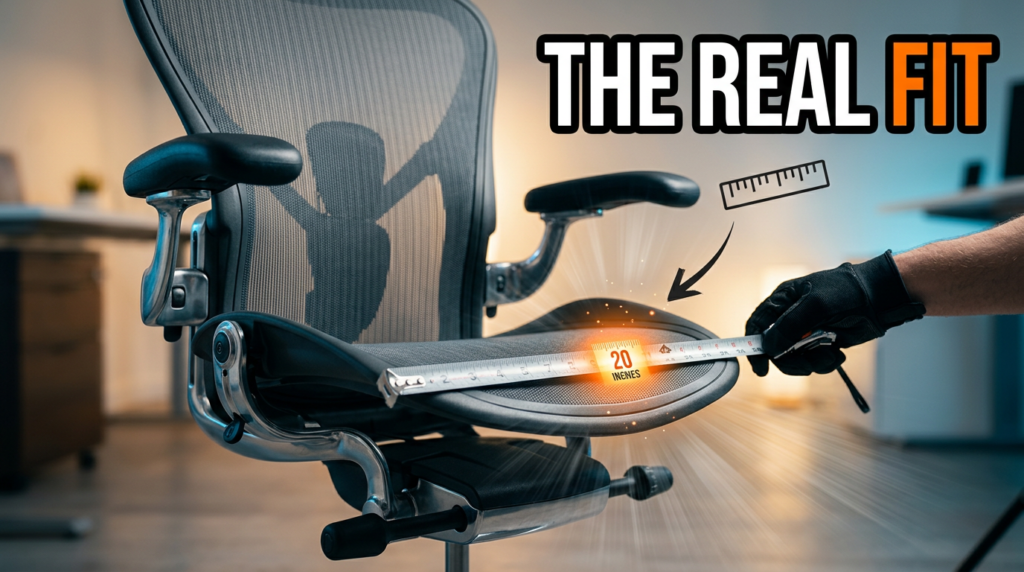
This is the most overlooked measurement. It is also the most important one for tall people. Seat depth is the distance from the back of the seat to the front edge.
Too shallow, and your thighs have no support. Too deep, and the front edge digs into the back of your knees. That cuts off circulation.
A simple test: sit all the way back. Check that two to three fingers fit between the seat edge and the back of your knees. For most tall users, that means looking for a seat depth of at least 19 inches — and sometimes up to 22 inches. A chair with no seat depth adjustment is often a dealbreaker for a tall frame.
More Measurements You Cannot Skip
Most buyers stop after checking seat height. That is a mistake. Three more measurements directly affect how a tall person feels after hours of sitting.
Measurement 3: Backrest Height
Have you sat in a “high-back” chair where the backrest ends at your shoulder blades? That is a classic design failure for tall users. A proper backrest supports your entire thoracic spine — all the way up to your shoulders.
For someone with a long torso, look for a backrest height of at least 24 inches. This prevents hunching and reduces neck and shoulder strain. An adjustable headrest is a nice bonus — but only if the main backrest is already tall enough.
Measurement 4: Height-Adjustable Lumbar Support
Nearly every chair claims to have lumbar support. For tall people, the question is not whether it has lumbar support. The question is where that support hits your back.
A fixed lumbar on a standard chair often hits a tall person too low. It pushes against the sacrum instead of supporting the natural lower back curve. That does more harm than good. Look specifically for height-adjustable lumbar support. Moving it up or down is non-negotiable for a taller spine.
Measurement 5: 4D Armrests
Poorly positioned armrests force your shoulders to hunch. They make your arms flare out. Over time, this builds serious tension through the neck and upper back.
Standard armrests are often too low or too close together for tall people. That is where 4D armrests make a real difference. They adjust in four directions: up and down, in and out, forward and backward, and pivot. This lets you place the armrests right under your forearms while typing. Your shoulders stay relaxed. Your upper body stays neutral. For tall users, this is not a luxury — it is a necessity.
Best Office Chairs for Tall People: Three Picks That Get It Right
Now that you know what to look for, here is how these principles apply to real chairs. These three examples cover different price points. They are chosen based on how well each one hits the five measurements — not as a paid ranking.
Budget Pick (Under $400): Secretlab TITAN Evo XL
Gaming chairs are hit or miss on ergonomics. But the Secretlab TITAN Evo gets a lot right for tall users. The XL version fits people up to 6’9″ and 395 pounds. It hits several key measurements well. The backrest is genuinely tall. Seat depth is solid. The integrated lumbar support adjusts for both height and depth — a great feature at this price. The 4D armrests are also well-built.
The foam is firm. Some users love that. Others find it less comfortable over very long sessions. Still, as a budget entry into tall-friendly seating, it is hard to beat.
Mid-Tier Pick ($500–$900): Steelcase Gesture
The Steelcase Gesture is a master of adjustability. Its standard seat height reaches 21 inches. Taller gas cylinders are sometimes available for extra height. The headline feature is its “360-degree” armrest system. It moves like a human arm — supporting different postures throughout the day.
Seat depth adjusts to around 18.75 inches. That works well for many tall users. But people at 6’4″ and above should test it in person first. Overall, the Gesture is a strong choice for dynamic, flexible support.
Premium Pick (Over $1,000): Herman Miller Aeron Size C
Any serious conversation about the best office chairs for tall people leads here. The key is simple: skip Size A and Size B. Go straight to Size C. Herman Miller’s own sizing charts show Size C works for users up to around 6’6″. It has a taller back and a deeper, wider seat.
The mesh design is exceptionally breathable. The PostureFit SL system provides both sacral and lumbar support — each adjustable independently. The seat depth on Size C is fixed at 18.5 inches. For most tall users within its intended height range, though, the Aeron Size C delivers a level of fit that very few chairs match.
As Wirecutter’s long-term testing has consistently noted, the Aeron remains one of the best-supported ergonomic investments for people who spend serious time at a desk.
Your Shopping Checklist Before You Buy
The point of all this is not to push you toward one chair. It is to give you the power to evaluate any chair properly. Use this checklist every time you shop — online or in a store.
1. Maximum Seat Height — Does it reach at least 20–21 inches?
2. Seat Depth Adjustment — Can it reach at least 19 inches? Is it adjustable?
3. Backrest Height — Will it reach and support your full shoulder blades?
4. Lumbar Support — Is it height-adjustable, or stuck in one fixed position?
5. Armrests — Are they 4D? Can you adjust height, width, and depth?
If a chair misses on two or more of these points, it is probably not right for your frame. Do not compromise on these fundamentals. They separate a chair that looks good from one that actually protects your back every day.
The Real Takeaway
For years, tall people were told to grab something labeled “big and tall” and make it work. That advice ends here.
Real comfort does not come from a label. It comes from a proper fit. Seat height, seat depth, backrest height, lumbar placement, armrest position — these five things separate a chair that works from one that leaves you reaching for pain relief by mid-afternoon.
A good chair is a long-term investment. It protects your health, your focus, and your daily output. Take these measurements. Use this checklist. Go find a chair that was genuinely built to fit you.
FAQ: Best Office Chairs for Tall People
Q1: What are the best office chairs for tall people overall?
A: The best office chairs for tall people prioritize seat height of 20–23 inches, seat depth of 19+ inches, backrests of 24+ inches, height-adjustable lumbar support, and 4D armrests. Top picks include the Secretlab TITAN Evo XL, Steelcase Gesture, and Herman Miller Aeron Size C.
Q2: What seat height do I need if I am over 6 feet tall?
A: Most people over 6 feet need a seat height of at least 20–21 inches. Anyone over 6’4″ should look for chairs reaching 22 inches or higher — or models that accept a taller aftermarket gas cylinder.
Q3: Why does seat depth matter so much for tall people?
A: Seat depth determines thigh support. Too shallow and legs hang unsupported. Too deep and the seat edge restricts knee circulation. Most tall people need 19–22 inches of adjustable seat depth.
Q4: Is the Herman Miller Aeron good for tall people?
A: Yes — but only in Size C. Size A and B are for average or smaller frames. Size C is built for users up to around 6’6″ with a taller backrest and deeper seat.
Q5: What does “4D armrests” mean?
A: 4D armrests adjust in four directions: height, width, depth, and pivot. For tall people with longer arms and broader shoulders, this adjustability keeps posture neutral during long work sessions.
Q6: Should tall people buy “big and tall” labeled chairs?
A: Not automatically. The label addresses weight and width — not the proportional needs of a tall body. Always check the five key measurements instead of relying on the label.
Q7: What backrest height should tall people look for?
A: Look for at least 24 inches of backrest height. This ensures full thoracic spine support up to the shoulders — which prevents the neck and shoulder strain that shorter backrests cause over time.