
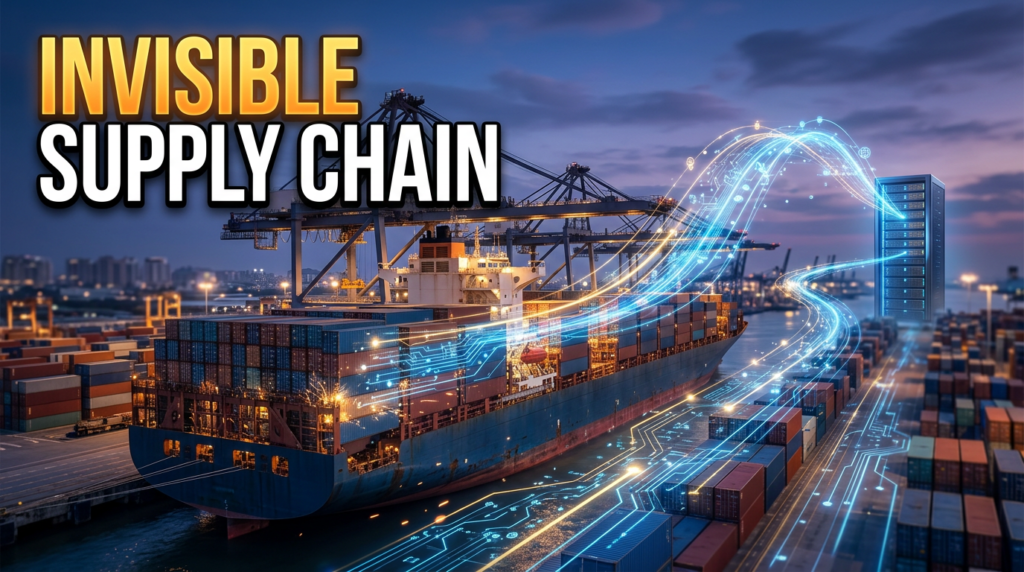
The Data Supply Chain: The Invisible Engine Behind Every Smart Business Decision
When most people think of a supply chain, they picture ships, trucks, and warehouses moving physical products around the world. But the most valuable supply chain in modern business moves something entirely different. The data supply chain is the hidden system that powers every smart decision, every competitive advantage, and every company that consistently wins in the modern era. You can’t touch it. You can’t see it. Yet in 2026, there’s a growing argument that it matters more than all the trucks and ships combined.
What Is a Data Supply Chain? The Complete Lifecycle Explained
Here’s the core idea: a data supply chain is the complete lifecycle of data within an organization, from its creation all the way to its final use in making a decision. It’s the system that takes raw, messy information and turns it into something people and algorithms can actually act on.
Think of it like a professional kitchen. Raw ingredients arrive from different suppliers — vegetables from one farm, spices from another, meat from a local butcher. On their own, they’re just a pile of unrelated stuff. But then the kitchen gets to work. Ingredients get washed, sorted, chopped, and measured. They combine in a specific recipe, cook at the right temperature, and plate for a customer. Only then does a finished meal reach the table.
The Three Phases: Creation, Processing, and Consumption
The data supply chain follows the same three-phase structure. First, data is created and collected from dozens — or even hundreds — of sources simultaneously. These include a company’s own Enterprise Resource Planning (ERP) and Customer Relationship Management (CRM) systems, IoT sensors on factory floors, logistics feeds from shipping partners, and external inputs like weather forecasts or market trend data.
However, raw data is almost always messy. It tends to be fragmented, inconsistent, and riddled with errors. So the next phase focuses on processing: cleaning, standardizing, and enriching the data to make it genuinely reliable. This step is the equivalent of washing the vegetables. It ensures that what moves downstream is high quality, not garbage in disguise.
Finally, the finished data product — clean, trusted, and accessible — gets distributed to its consumers. Those consumers might be analysts building dashboards, executives reviewing performance metrics, or, increasingly, AI models making fully automated decisions in real time.
The entire journey from a pile of raw numbers to a critical business insight is the data supply chain. And the companies that master this flow of information build an almost unbeatable competitive advantage.
Why the Data Supply Chain Became the Nervous System of Modern Business
This concept isn’t entirely new. However, the reason everyone is talking about it now is that the speed of business has fundamentally changed. The old model treated the supply chain as something you reviewed after the fact — in weekly or monthly reports. You looked at what happened and then tried to do better next time.
That model is now obsolete. Disruptions happen in real time, and companies are expected to react just as fast. A well-built data supply chain allows managers to shift from reactive problem-solving to proactive, predictive planning. That shift is enormous.
From Reactive to Predictive: The Real-Time Advantage
Microsoft’s supply chain platform illustrates this well. It ingests data from ERP systems, logistics feeds, and vendor networks, processing purchase orders, shipment tracking, and inventory levels as they occur. When properly configured, this kind of architecture creates a near-real-time unified picture of the entire operation. When a company can correlate historical data with live information, it doesn’t just see a delay — it predicts a delay before it actually happens.
That’s a monumental capability shift. A business can spot a potential disruption — a supplier risk, a weather event, a port closure — and automatically simulate the best response. It can reroute shipments, reallocate inventory, and update customers before a problem becomes a full crisis.
However, getting this right is genuinely difficult. Poor data quality can silently disrupt everything from demand forecasting to inventory planning, long before any team even realizes what’s going wrong. If a dashboard reports inventory is fine but the warehouse is actually empty, the data supply chain has failed. This is why the conversation has expanded well beyond technology to include data governance — the policies, standards, and controls that ensure data stays accurate, consistent, and secure throughout the entire pipeline.
As MIT Technology Review has documented in its coverage of how modern data infrastructure separates high-performing companies from their slower competitors, the organizations that treat data governance as a core business function — not an IT afterthought — consistently outperform those that don’t. Without governance, a data pipeline isn’t a supply chain. It’s just organized chaos.
Treating Data as a Product: The Mindset That Changes Everything
This brings us to one of the most powerful ideas reshaping how organizations think about information: treating data as a product. For decades, most companies treated data as a byproduct of business operations — like exhaust from an engine. It accumulated in data warehouses, where it was hard to find, difficult to use, and rarely trusted by the people who needed it most.
The “Data as a Product” (DaaP) approach flips that entirely. It argues that datasets should be treated with the same discipline and intention as any product a company creates and sells. Each “data product” has a dedicated owner, a clear roadmap, and is designed specifically with the end consumer in mind.
What Makes Something a True Data Product
A true data product isn’t just raw data sitting in a database somewhere. It’s a curated, reliable, and accessible asset built to solve a specific business problem. To qualify, it must be discoverable through a catalog, have a permanent and addressable location, be provably trustworthy, and be self-describing — meaning it comes with clear documentation explaining what it is, where it came from, and how to use it.
For example, a “Customer 360” dataset might function as a data product owned and maintained by the marketing team. They take responsibility for its quality, ensuring it integrates data from sales, customer service, and online behavior to deliver a complete and accurate view of each customer. Any team that needs that view can subscribe to this trusted product, confident it is accurate and current.
This approach is the direct opposite of the old, centralized IT bottleneck model. In a data-as-a-product world, the teams closest to the data own and share it. This decentralized philosophy — often called a “data mesh” — makes organizations significantly more agile and allows data to flow seamlessly from creators to consumers.
As Wired has explored in its analysis of how the data mesh architecture is reshaping enterprise data strategy, companies that successfully implement this model report faster decision-making cycles and dramatically reduced friction between the teams who generate data and the teams who need it. The result is a culture of self-service analytics that scales far better than any centralized model can.
AI and the Future: When the Data Supply Chain Starts to Think for Itself
If a data supply chain is the system that moves information, what happens when that system starts to reason and act autonomously? This is exactly where Artificial Intelligence is transforming the data supply chain into something more like a central nervous system for the entire business.
The future of AI in this space isn’t just about creating better dashboards or generating cleaner reports. It’s about autonomous decision-making — systems that can perceive, reason, and act on data in real time with minimal human intervention.
Agentic AI: From Flagging Problems to Resolving Them
The emerging concept of “agentic AI” describes autonomous systems that move beyond simply alerting a human to a problem. Instead of flagging a disruption for review, the vision is for an AI agent to automatically analyze the issue, simulate multiple response scenarios, and execute the best solution — often before a human is even aware the problem exists.
Some advanced systems in active development pursue exactly that capability. An agent could detect a port closure from a live news feed, identify every shipment currently routed through that port, and automatically rebook those shipments with alternative carriers on new routes. That’s not a prediction. That’s a resolved issue. While this level of autonomy isn’t yet a universal standard, leading logistics firms are actively piloting these capabilities today.
More broadly, AI-powered forecasting is already showing measurable results. Sophisticated AI systems can handle millions of freight price quotes, book shipments, and track delivery status in real time. This combination of AI, machine learning, and process automation — sometimes called hyperautomation — is reducing manual workload significantly while improving both speed and accuracy.
Ultimately, this progression allows businesses to move from simply being data-driven to becoming genuinely intelligent and predictive. Studies of AI-powered supply chain systems suggest the potential to reduce forecasting errors by up to 50% in some applications, while also cutting inventory carrying costs and improving resilience against the kinds of external shocks that have become far too familiar in recent years.
The Real Competitive Frontier: Information, Not Inventory
Companies like Amazon and Apple are widely recognized as masters of the physical supply chain. But a core part of their underlying competitive edge comes from their mastery of the data supply chain. They don’t just move products faster. They move information smarter.
The journey from raw, messy data to an automated, intelligent action is the new competitive frontier. The companies that win over the next decade won’t necessarily be the ones with the most data. They’ll be the ones with the most reliable, efficient, and intelligent flow of information.
Data itself isn’t the new oil. The real value lies in the refinery — the data supply chain that takes raw material and turns it into usable fuel for decisions, predictions, and actions.
So the next time a delivery arrives perfectly on time, or a company responds instantly to a global disruption before competitors even notice it, consider the invisible engine working in the background. The smartest companies have already understood the fundamental truth of modern business: to master the movement of things, you first have to master the movement of information.
And that raises a genuinely important question about where this is heading: as intelligent data systems become the backbone of global commerce, who will hold the real power — the companies that make the products, or the ones that control the data deciding where those products go?
FAQ — Data Supply Chain
Q1: What is a data supply chain in simple terms?
A: A data supply chain is the system that moves data from its raw form to business use. Like a physical supply chain that turns raw materials into finished products, it transforms raw data into reliable insights. Every organization has a data supply chain, even if it was not intentionally designed.
Q2: How is a data supply chain different from a traditional supply chain?
A: A traditional supply chain moves physical goods through suppliers, manufacturers, and distributors. Similarly, a data supply chain moves information through collection, processing, governance, and consumption. Unlike physical goods, data can be copied and shared across many destinations. It can also help improve the performance of the physical supply chain, making the two systems closely connected.
Q3: Why does data quality matter so much in a data supply chain?
A: Poor data quality causes cascading failures downstream. When inventory data is inaccurate, business decisions can be wrong. Data quality failures often go undetected until they’ve already distorted forecasts, triggered incorrect orders, or created customer-facing problems. Reliable systems include quality checks at every stage of the data supply chain. Unreliable systems often wait until the end.
Q4: What is data governance and why does it matter?
A: Data governance refers to the policies, standards, roles, and controls that determine how data is collected, stored, used, and maintained across an organization. Without governance, even technically sophisticated data pipelines produce unreliable outputs because no one is responsible for ensuring accuracy, consistency, or security. Strong governance transforms a collection of data pipelines into a trustworthy system that people across the organization are actually willing to rely on.
Q5: What does “data as a product” mean in practice?
A:Treating data as a product means managing datasets with clear ownership, quality standards, and user needs in mind. Each important dataset should have a designated owner, documented specifications, and a known location in a data catalog. It should also meet measurable quality standards. The goal is to make data reliable, reusable, and valuable across the organization.