Blind Hiring: The Radical Experiment That Exposed the Real Problem With Bias
What if the fairest way to hire someone was to know absolutely nothing about them? No name, no face, no clues about their background. Blind hiring promised exactly that — a recruitment process stripped of the personal details that trigger unconscious bias. The idea was elegant, the research behind it compelling, and the corporate uptake real. But the results told a more complicated story. Instead of eliminating bias, the experiment revealed something unsettling: human bias is a shapeshifter, and blocking it in one place just sends it somewhere else.
Why Hiring Has Always Been Biased — and Why That’s Hard to Fix
Hiring has always been a messy, deeply human process. And humans, whether they acknowledge it or not, operate through invisible shortcuts. Everyone carries a library of unconscious biases — mental patterns that help make sense of the world but produce deeply unfair outcomes.
A now-famous 2004 field experiment made the scale of the problem impossible to ignore. Researchers sent out identical resumes, with the only difference being whether the applicant had a distinctively “white-sounding” or “Black-sounding” name. Resumes with white-sounding names received 50% more callbacks. That means applicants with certain ethnic-sounding names may need to send out significantly more applications just to get the same shot at an interview.
Why Our Brains Make This Worse
The uncomfortable truth is that most hiring managers aren’t sitting in their offices with malicious intent. Instead, their brains are wired for pattern recognition — and sometimes those patterns build themselves on stereotypes about names, ages, genders, or the university someone attended. These biases operate below conscious awareness, yet they consistently slam doors on talented people before anyone even reads their qualifications.
It’s a problem as infuriating as it is persistent. So a new idea emerged — one that seemed almost too simple to fail.
What Blind Hiring Promised — and the Evidence That Backed It Up
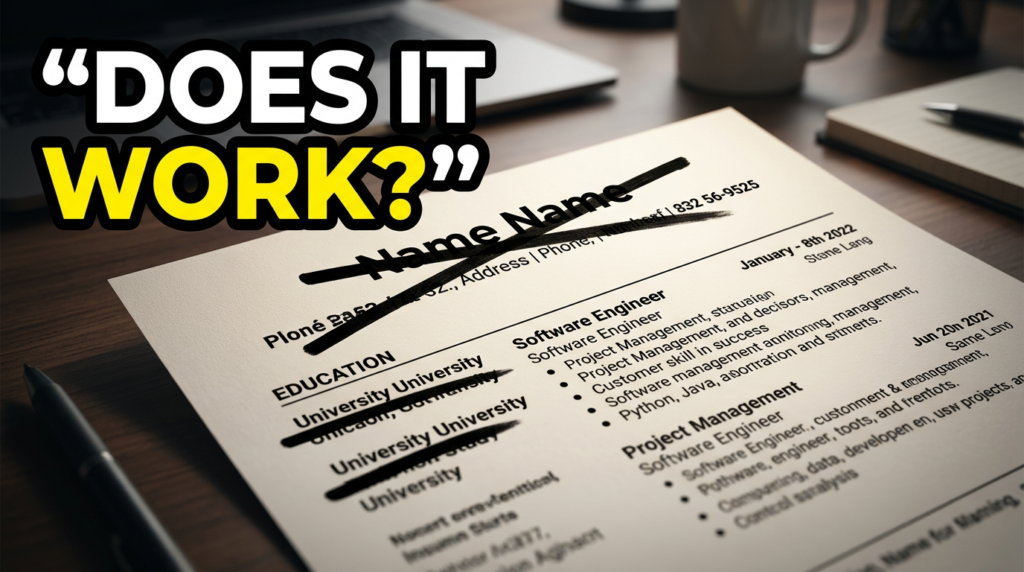
The concept of blind hiring was straightforward and, on paper, genuinely elegant. If bias is triggered by personal information on a resume, simply remove that information. Companies began scrubbing resumes of identifying details: names, photos, addresses, graduation dates, and even university names. The goal was to force recruiters to focus on the only question that should actually matter — can this person do the job?
The inspiration for the corporate world came from a study of classical music. Starting in the 1970s, many orchestras began holding auditions behind a screen. A groundbreaking 2000 study by economists Claudia Goldin and Cecilia Rouse found that screen auditions increased the probability of a woman advancing from preliminary rounds by 50%. That result was dramatic and widely cited.
The Corporate Adoption of Blind Hiring
Armed with that precedent, major companies moved quickly. Deloitte, HSBC, and Google all began implementing blind hiring practices. The business case extended well beyond fairness, too. A strong body of research consistently shows that diverse teams produce more innovation, solve problems more effectively, and often perform better financially. If removing identifying details from resumes could help achieve that, companies felt they had both a moral and strategic reason to act.
For a moment, it genuinely looked like a silver bullet had been found. As Harvard Business Review has documented in its analysis of how structured approaches to hiring reduce bias and improve team diversity outcomes, the appeal of blind recruitment lies in its promise to shift focus from who candidates are to what they can actually do.
The Twist: Why Blind Hiring Didn’t Deliver the Utopia It Promised
Here’s where the story gets genuinely complicated. The utopia of perfect fairness didn’t materialize. Instead, companies discovered something deeply unsettling: bias doesn’t disappear when you hide a name. It relocates.
The most surprising evidence came from a large-scale experiment run with the French public employment service. When companies voluntarily adopted anonymous resumes, minority candidates actually became less likely to get an interview — the exact opposite of what everyone expected.
How the “Cobra Effect” Appeared in Hiring
Researchers offered a theory for this reversal. The firms that chose to participate in the study were already predisposed toward diversity. When they could see a minority-sounding name on a resume, they were often more willing to overlook small warning signs — a gap in employment history, for instance — because they had a conscious motivation to include diverse candidates. When names vanished, that context disappeared. A gap in a resume became just a gap, and it was judged more harshly. The effort to be color-blind ended up hurting the very people it set out to help.
This revealed a deeper problem. Blind hiring at the resume stage only delays the inevitable. You can anonymize a resume, but you cannot anonymize a person. The moment a candidate appears on a video call or walks into an interview, every signifier of identity — gender, race, age, accent — floods back into the room. If the interview itself is an unstructured, gut-feeling conversation, all that initial effort is effectively wasted. Bias doesn’t disappear at the resume screen. It simply migrates to the next stage.
The Real Problem: How Our Brains Sabotage Fair Evaluation
This points to the genuine villain in the story — not a person with prejudiced beliefs, but the underlying wiring of the human brain itself. Nobel laureate Daniel Kahneman describes this as “System 1” thinking: fast, automatic, intuitive judgments that help navigate daily life but create serious distortions in fair evaluation.
Several specific cognitive traps make hiring particularly vulnerable. “Affinity bias” drives us to warm to people who feel familiar and similar to us. The “halo effect” leads us to view everything about a candidate positively once we’ve spotted one impressive trait, like attendance at a prestigious university. “Confirmation bias” causes interviewers to form an impression in the first few seconds and then spend the rest of the conversation searching for evidence to confirm that initial gut feeling.
Why “Culture Fit” Is Often the Problem in Disguise
An unstructured interview — the kind that feels like a casual, friendly chat — is a minefield for all three biases simultaneously. The conversation naturally drifts toward personal connection. The hiring manager isn’t trying to be unfair; they’re trying to gauge “culture fit.” But that phrase is vague enough to become a quiet stand-in for “is this person like me and my friends?”
The failure of simplistic blind hiring wasn’t a failure of intent. It was a failure to understand the true scope of the problem. Bias doesn’t live only in the resume screen. It lives in the whole system — the subjective impressions, the inconsistent questions, and the fuzzy definitions of what “good” actually means. Patching one hole doesn’t fix a leaking roof.
What Actually Works: Structured Hiring as the Real Solution
Just because the first wave of blind hiring fell short doesn’t mean the core idea was worthless. Its failures delivered something far more valuable than easy success — they forced a much more precise diagnosis of the problem.
The true power of blind hiring isn’t just about hiding identity. It’s about forcing organizations to define what merit actually looks like before anyone reviews a single candidate.
Skills Assessments and Structured Interviews
When recruiters can no longer rely on shortcuts like a university’s reputation or a familiar-sounding name, they must ask a harder and better question: “What specific skills and competencies actually predict success in this role?”
This insight gave rise to what practitioners now call structured hiring — a more rigorous and holistic approach. It starts with job descriptions that use neutral language, continues with anonymized resume screens, and then adds two additional layers that make all the difference.
First, skills-based assessments. Rather than simply reading about what a candidate has done, companies ask them to actually demonstrate it. A coding challenge for a programmer, a writing test for a marketer, a case study for a consultant. This shifts the entire focus from pedigree to performance.
Second, structured interviews. Every candidate answers the exact same set of job-related questions, in the same order, scored against a pre-defined rubric. Decades of industrial-organizational psychology research show this approach substantially outperforms unstructured conversation in predicting actual job performance. It doesn’t remove the human element — it channels it. Evaluators must be consistent and justify their assessments with evidence rather than impressions.
As Entrepreneur has explored in its coverage of how structured hiring practices reduce unconscious bias and improve long-term hire quality, companies adopting this comprehensive model report hiring more diverse candidates who consistently perform well in their roles.
The Future of Fair Hiring: Technology, AI, and Better System Design
This evolution points toward a larger conversation about where hiring is heading. As more of the process moves online, companies are adopting everything from Applicant Tracking Systems to AI-powered screening tools. That technology presents both genuine promise and real danger.
On one hand, an algorithm can be programmed to reliably ignore names, gender markers, and age in ways that human reviewers struggle to maintain consistently. On the other hand, AI can amplify bias at enormous scale if trained on flawed historical data. Amazon discovered this firsthand when it had to scrap a recruiting tool that had learned to penalize female candidates — because it trained on a decade of hiring data from a male-dominated workforce. The machine simply learned the company’s old habits.
The future of fair hiring, therefore, isn’t about choosing between humans and machines. It’s about designing better systems. Technology should enforce the principles of structured hiring — clear criteria, consistent evaluation, and a focus on measurable skills. The human role shifts from making snap judgments to designing equitable processes and making thoughtful final decisions grounded in rich, comparable data.
What This Means for Job Seekers, Hiring Managers, and Company Leaders
The lessons here are practical and apply at every level.
If you’re a job candidate, the most important shift is showing rather than just telling. Build a portfolio, contribute to projects, and create concrete work samples wherever possible. Prepare for a world that increasingly values demonstrated competence over institutional credentials.
If you’re a hiring manager, it’s worth questioning your current process honestly. Are your interviews structured evaluations with consistent criteria, or are they friendly chats that rely on gut feeling? Even adopting a simple structured interview format can dramatically reduce bias and improve the consistency of your hiring decisions.
If you lead an organization, the core message is that fairness is a design problem. Blind hiring alone isn’t the answer. It’s one valuable tool inside a much larger system that needs to be deliberately and continuously improved.
The path to fair hiring is rarely a straight line. It’s an iterative process of experimenting, learning from what doesn’t work, and building something better. Blind hiring didn’t create the utopia its proponents hoped for. But it did something more important — it exposed just how deep the problem runs, and pointed toward the more rigorous, systemic solutions that can actually move the needle.
FAQ — Blind Hiring
Q1: What is blind hiring and how does it work?
A: Blind hiring is a recruitment approach that removes personally identifying information from job applications before they reach recruiters. This typically includes stripping out names, photos, addresses, graduation years, and sometimes university names. The goal is to reduce unconscious bias at the initial screening stage by forcing evaluators to focus on skills and experience rather than personal details.
Q2: Does blind hiring actually reduce bias in recruitment?
A: The evidence is mixed. Blind hiring can reduce some bias during resume screening, but studies show it doesn’t always improve outcomes. In some cases, minority candidates received fewer interview opportunities because evaluators lacked context. It tends to work best as part of a broader, structured hiring process rather than as a standalone solution.
Q3: What companies use blind hiring practices?
A: Several major organizations, including Deloitte, HSBC, and Google, have adopted blind hiring practices. Many public-sector employers have also tested anonymous resume screening. However, the strongest results typically come from combining anonymization with structured interviews and skills-based assessments.
Q4: What is structured hiring and how is it different from blind hiring?
A: Structured hiring takes a broader approach to fair recruitment. Beyond anonymized resumes, it uses skills-based assessments and standardized interviews with clear scoring criteria. Research consistently shows that this method predicts job performance more accurately than unstructured interviews.
Q5: Why did Amazon’s AI recruiting tool fail, and what does it tell us about bias?
A:Amazon’s AI recruiting tool trained on a decade of hiring data that skewed heavily male. As a result, it learned to penalize resumes associated with female candidates. Amazon scrapped the tool in 2018, highlighting how AI can amplify existing biases when trained on biased historical data.
Q6: What is unconscious bias in hiring, and what types are most common?
A: Unconscious hiring bias refers to automatic mental shortcuts that influence candidate evaluations without awareness. Common examples include affinity bias, the halo effect, and confirmation bias, all of which are especially common in unstructured interviews.